We left off at our last night in Puno. The next morning we took the Inka Express bus to Cusco. It's about a twelve hour trip. Much longer than on our way the opposite direction because this is the tourist bus and it makes multiple stops. It was a good way to travel, thought not as luxurious as the first ones we took earlier in the trip. To get to to the bus station, we rode in a mototaxi. A wanted to ride in one this whole trip. It's essentially a covered three-wheeled motorcycle. Very bumpy ride, but extremely cheap! You can see them in this photo.

When we board the bus, one of the American couples from our Lake Titicaca tour gets on as well. Nice to see familiar faces. After about an hour, we drive through Juliaca (where the airport closest to Puno is). Our guide tells us some interesting tidbits: 1) Houses are purposely left unfinished so they pay less taxes. 2) Locals sell illegal Bolivian imports here, including gasoline. We get the impression most Peruvians don't like this city, they just use it for the airport.
Our first stop is Pukara. Our guide led us through the museum and gave a very detailed overview of all the cultures throughout Peru's timeline. The main idea is the Incas absorbed most if not all pre-Inca cultures into their own. The Pukara were the ones who put llamas on the roof of their houses. The Spaniards changed them to bulls. No photos in the museum, but I got one from the hip of their most popular idol, the decapitator.
As we drove away, we saw herds of llamas, alpacas and vicunas. Our guide told us how to tell them apart and that vicunas are protected.
Next we stopped briefly at La Raya pass, the highest point in the trip. 14,222 feet! Yes, I am leaning on to and clutching the sign post. (Still wasn't feeling amazing.) This is the governmental line between Cusco and Puno. Here we were initiated into an interesting concept - Peruvians are at every place tourist buses stop, even if it's not a spot for a true tour, selling their wares. Usually it's similar if not the same merchandise.
Behind A are the Bolivian Andes. (And people selling stuff.)
There were people willing to pose with their llamas for photos in exchange for money.
Soon after we drove away from the pass the scenery started changing. More trees. Less flat grassland. Good-bye, altiplano! We stopped in Sicuani for a buffet lunch where we met up with two other Inka Express buses. One going our way, the other heading the opposite. Very touristy. They had a band playing and walking around for tips and trying to sell their CD.
Next up was Raqchi, an Inca temple. It was mostly destroyed by the Spanish. The largest central wall from the temple is still standing. They surrounded the site with a 3-meter high, 2-meter thick, 5-kilometer long wall.
This central walkway between the buildings lined up with the sun during the winter solstice in Inca times. They tended to align walkways or buildings with the sun during one of the solstices.
The Inca sacrificed llamas here and also had storage for the "taxes" the people had to pay in the form of grain, corn, etc. Our guide also told us gold and silver weren't that valuable (the Inca had plenty) but seashells were considered extremely precious as they were scarce and represented Mother Sea.
Our final stop before reaching Cusco was to see the Jesuit church in Andahuaylillas. Population: 840. The church was built on top of an Incan temple. (A common practice, we came to find.) First the Jesuits were in control and added many Andean-inspired art pieces. Then the Dominican order took over and covered some of the art on the walls with gold-framed Renaissance-style paintings. The ceiling is also painted in an intricate design. (No photos allowed, but I got lucky with a blind shot.) The organs are supposedly the oldest in Latin America (16th century) and are still used every Sunday.

A quick note on taking photos where they are not allowed... I completely understand prohibiting flash photos. Flash does have ill effects on art work. Just taking a non-flash photo does not. If the site offers postcards for sale and that is the reason they prohibit photos, I will tend to buy a postcard instead if they are not a complete rip-off. But in most cases, there were no postcards or any options for a visual to remember the site by. So I felt completely justified in taking some off-the-hip photos.
Back to the journey... When we were close to Cusco we saw one of an Incan structure they've come to call "gates". Very big. Our guide said they served as gateways into the Incan capital of Cusco.
Once we arrived at the Cusco bus station, we headed out to find a taxi but were soon approached by a driver from our hotel. (I had forgotten I'd asked them to send someone!) We stayed at Piccola Locanda. It is a super cute hotel. There is only one downside: You have to walk up a hill and then up a set of stairs to get to the hotel. The hill wasn't too bad.
The stairs were rough. (At least, before we came back from the Inca Trail!)
This was our first room (where we stayed before the Inca Trail). It overlooked the Plaza de Armas (main square).
We dropped off our bags and headed out to explore. About three blocks away from the main touristy area around the Plaza de Armas we found a supermarket. Just like a Jewel-Osco or Albertson's, but 10 times crazier and busier. We stocked up on water, chocolate and juice. (Chocolate is recommended for high altitude hiking.) Then we sought out a guidebook recommendation for dinner. Los Toldos is known for their rotisserie chicken. It was packed with locals (that's how we knew we were on to something).
A tried the specialty drink of Cusco - Chicha morada. It's a sweet purple corn drink. (Non-alcoholic.)
We split a half chicken dinner. Super delicious. They have unique spices we couldn't decipher.
That night was the first night since Nasca that I slept well. I started to feel better at the altitude in Cusco, though I still tired easily and had a headache most of the time.
The next morning we ran to get money from the ATM and them met Percy, our tour guide/driver, in front of the cathedral at 9:00AM. We hired Percy for two days before the Inca Trail, and then for two days after. Money well spent! We were able to ask him all our questions, learn more about Cusco from a native, choose which sites we wanted to see and take our time when we were there.
Our first stop was Sacsaywaman. It's a temple on a hill overlooking Cusco. It's huge! And apparently we only saw about 20% of it. It's not all excavated and the Spaniards tore down some walls and re-used the stones in their own buildings. Archaeologists just discovered the terrace portion about five years ago.
Theoretically the site is the head of the puma that was Cusco city back in Inca times. There are two translations for Sacsaywaman - "puma lines" and "satisfied falcon". The Incas used giant limestone rocks to build it. Percy told us some people think it was a fortress, but they have never found any weapons there so he doesn't agree with that theory.
You can see how the Inca created their buildings... they fit stones together like puzzle pieces. No mortar, nothing like glue. Just rocks on top of and next to rocks. Proof of how great their architecture was: During the great earthquake of 1650, all the colonial buildings in Cusco collapsed but the ones with Inca foundations did not.
The view of Cusco from Sacsaywaman:
These are the terraces they found only recently. We even saw people working on excavations!
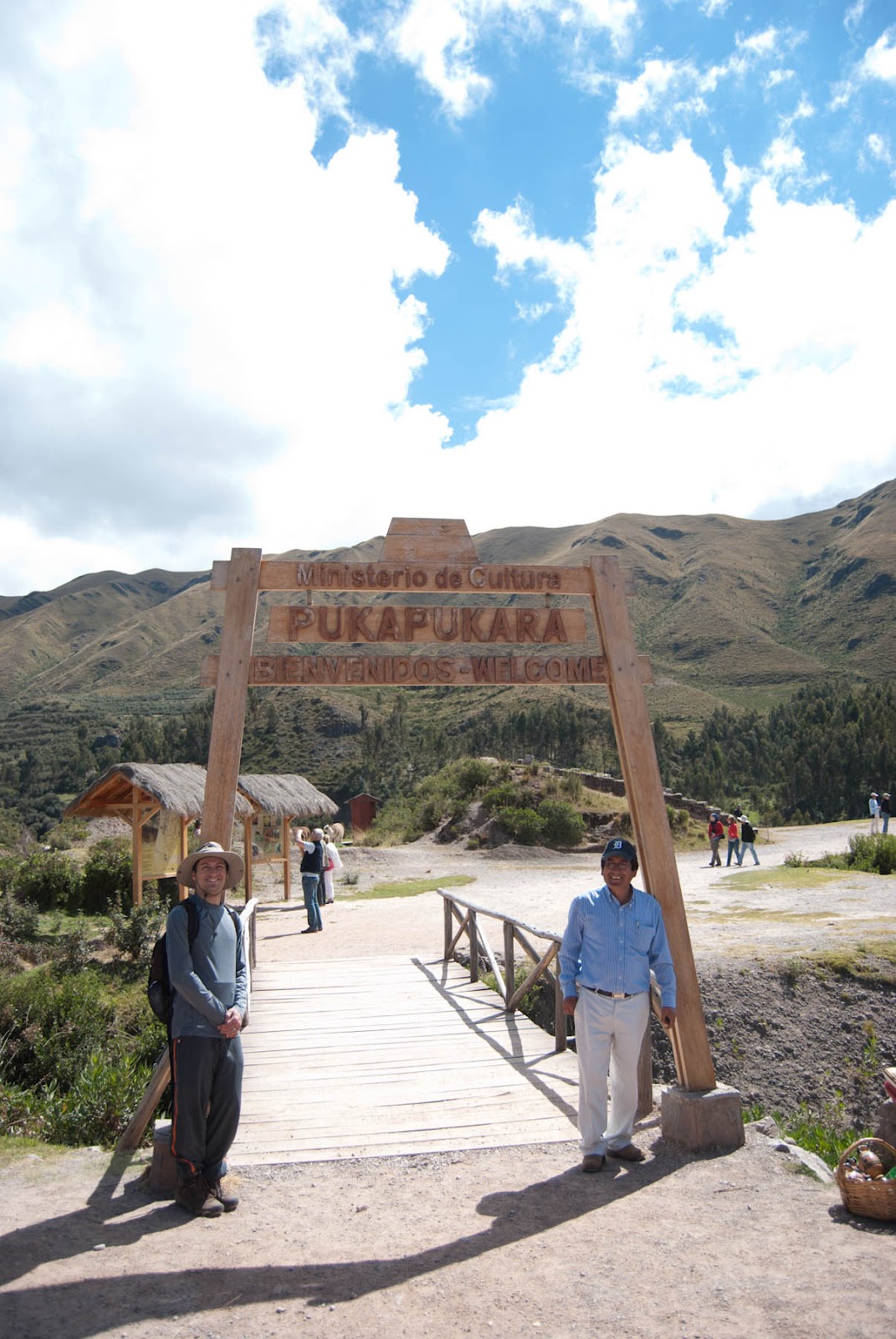
Next we went up the hill to Puka Pukara, which they think was a sort of rest stop on the Inca Trail. It has a place where you could pay your tax and sleep. Then you would travel 10-20 kilometers to the next one. It had a fountain which doesn't work now.
We went across the street (and up another hill) to Tambomachay. This site has a fountain fed by a natural spring. It was a religious site which had four altars for the four Inca states and two niches for the Inca king and his wife to sit in. Percy explained the three levels of Inca stone work (which are visible at this site).
Best = Large stones with straight edges which fit together perfectly. Imperial style used for temples and leaders' homes.
Better = Smaller stones with mostly straight edges (some rounded corners) which fit together well but not as great as Imperial. Used for administrative buildings.
Good = Smaller stones which mostly fit together and had some sort of mortar. Used for peasant-level buildings.
Next we drove down the hill to Q'enqo. They think it translates to "labyrinth". What a cool site. You first see this huge rock.
Then you walk around the side and see the Inca carved a path into the natural stone.
Inside the rock they carved out a chamber along with an altar. People used to think they made mummies there, but there was no evidence. Now they believe they sacrificed llamas inside the rock. There are two holes at the top of the rock and the Inca would pour liquid (possibly blood) into them. The liquid traveled down a groove and came to a split. One direction indicated good crops that season. The other meant bad.
Last we went to a factory where they taught us how to tell the difference between real alpaca, real baby alpaca and fakes. We avoided purchasing anything to do price comparisons.
Once back in town, we headed to a small restaurant recommended by Percy for lunch. 10 soles per person. (About $3.80 each.) They have a set menu for that price which includes a giant bowl of soup, your choice of entree (A had fish, I had spaghetti bolognese), dessert and a drink. Yes, they do Italian food in Peru. It's pretty popular. Tastes very different from Italian food in the States.
After lunch we went to the Museo Historico Regionale. It's inside the house of a famous Cusquenean - Inca Garcilaso de la Vega. He wrote a famous book about Inca customs. We had a great free guide who thought she didn't speak English well. Quite the opposite! She dressed in clothes traditional to her area.
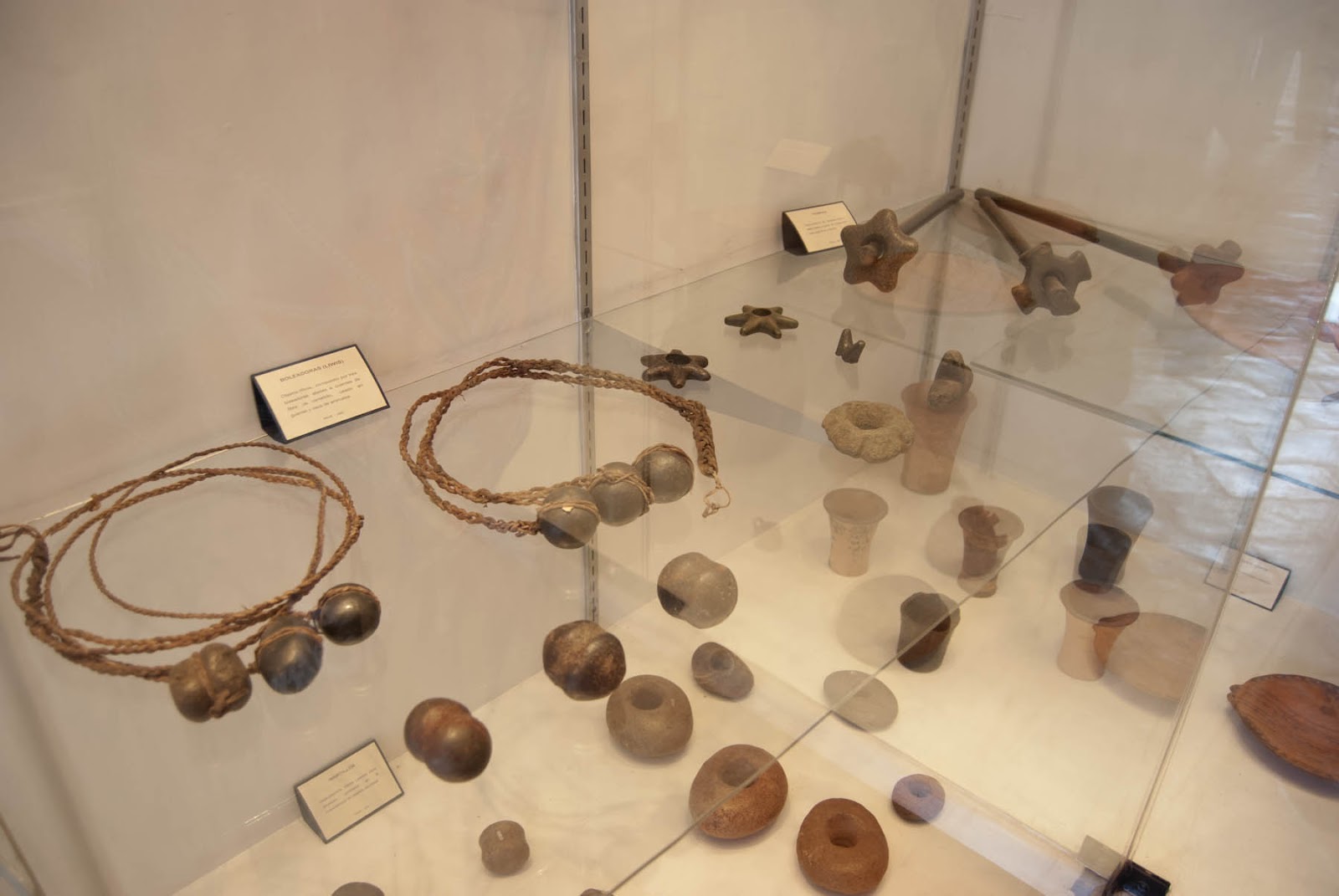
Many interesting things there... these are Inca weapons.
This is a Nasca mummy. Her hair is longer than her height.
After the museum we fought with ATMs to get enough money to pay the balance for our Inca Trail hike. Not easy when they only give you $200 max and then shut you out after one transaction. (Yes, the Inca Trail is expensive. But so worth it!)
We spent a little time at the Museo de Arte Contemporaneo. It had more offices in the building than art rooms, but had some interesting pieces. It was included in our Boleto Turistico, so we were okay with that.
Next we went walking to find the Peru Treks office where they briefed us on the hike and gave us our duffel bags to fill. Maximum weight limit = 2.5 kilos. That's only about 5 pounds, which we discovered is not very much!
We grabbed a snack in the form of tasty pastries. A had Pye Manzina (apple in a croissant dough) and I had a crumbly thing with some sort of chocolate icing. We ate them while in line at the Centro Qosqo de Arte Nativo. The show was also included in our tourist ticket. It was a collection of native dances from different parts of the Sacred Valley.
At this point, we had been in Peru for 10 days. Sad to say, we were craving burgers and caved to brave a fast food place called Bembo's. Mistake. Popular with the locals and the french fries were actually
fried, but their burgers were strange. No promise it was beef.
We dodged multiple touts for tours and massages and headed to the hotel.
Coming Up: Cheap Spanish tile, the true story about the Inca "gate", and chicharronnes!